

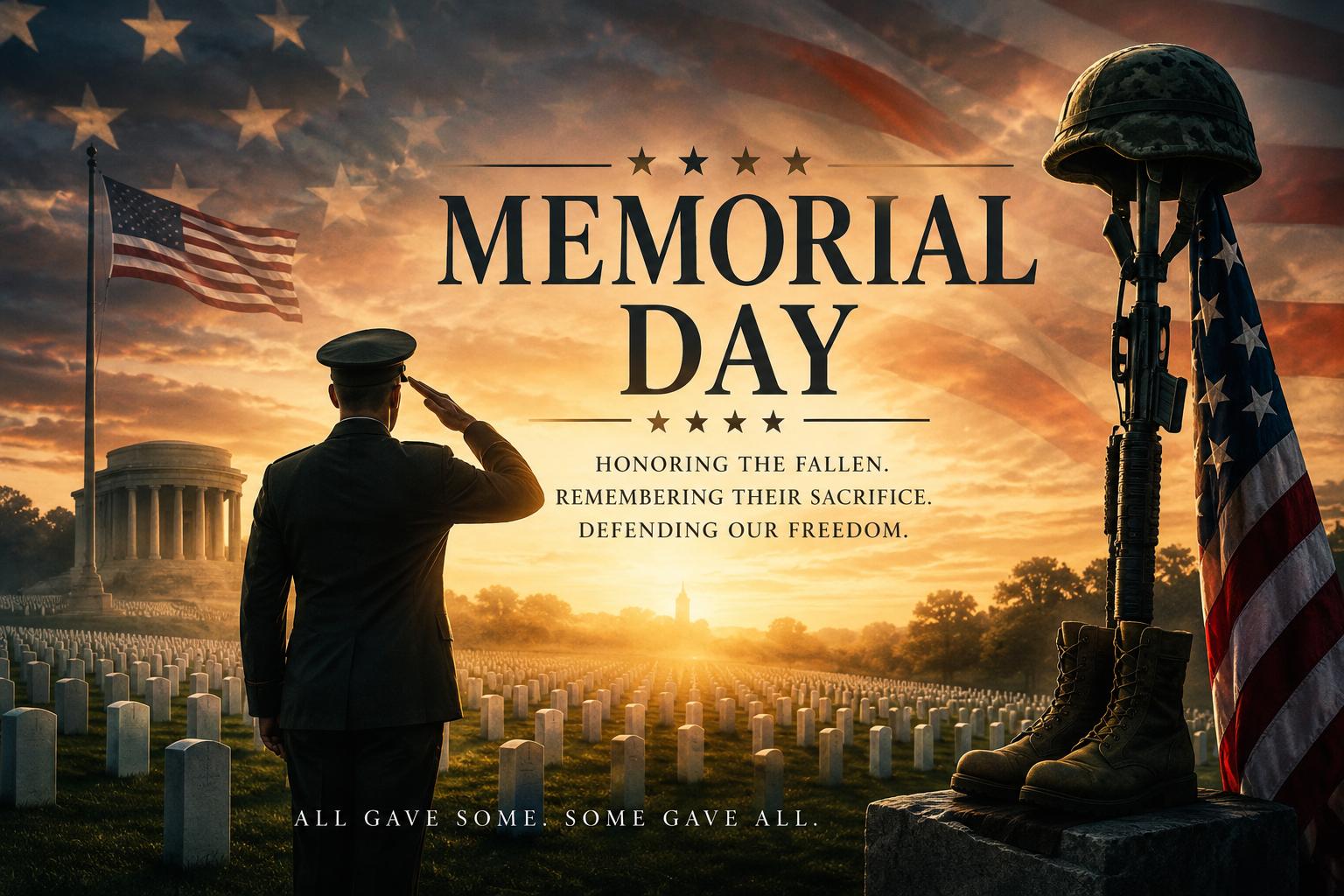
Every Memorial Day, Americans gather beneath waving flags, stand quietly in cemeteries, and remember the men and women who died serving in the United States military. For many, the holiday is deeply personal. It is a photograph framed on a mantle. A folded American flag resting in a display case. A son, daughter, father, mother, brother, sister, or friend who never came home. Memorial Day is not simply about military history. It is about sacrifice.
And at the center of that sacrifice is a question that has followed the country through every generation of war:
What were these Americans fighting and dying to protect?
For more than two centuries, American service members have fought in wars tied to the survival of the nation, the preservation of constitutional government, and the defense of individual freedoms. During the Revolutionary War, colonists fought against British rule in pursuit of self-government and liberty. The Declaration of Independence accused the British Crown of abuses of power, denial of representation, and violations of fundamental rights.
During the Civil War, hundreds of thousands died in a conflict centered on the preservation of the Union and the future of slavery in the United States. The war ultimately led to the abolition of slavery through the 13th Amendment and reshaped the country’s understanding of freedom and citizenship.
American forces later fought in World War II against fascist governments responsible for dictatorship, political repression, military aggression, and genocide. U.S. troops fought alongside Allied nations against regimes that imprisoned dissidents, silenced opposition, and denied basic human rights.
In later conflicts, from Korea and Vietnam to Afghanistan and Iraq, American leaders repeatedly framed military service as part of the defense of democracy, national security, constitutional government, and individual liberty.
The freedoms tied to those sacrifices are written directly into the Constitution and Bill of Rights.
– Freedom of speech.
– Freedom of religion.
– Freedom of the press.
– The right to peacefully assemble.
– Protection against unreasonable searches and seizures.
– The right to due process.
– The right to a fair trial.
– Equal protection under the law.
These principles are not abstract ideas. They are rights Americans have argued over, protested for, legislated, defended in courtrooms, and, in many cases, died protecting. This reality gives Memorial Day its emotional weight. The holiday forces the nation to confront not only the cost of war abroad, but also whether the freedoms paid for in blood are still being honored at home.
Across modern America, debates over civil liberties, policing, government authority, surveillance, censorship, excessive force, due process, and constitutional protections have become increasingly intense between those trying to take our rights and those who are protecting our rights.
Civil rights organizations, legal scholars, courts, journalists, and advocacy groups have documented repeated cases involving police misconduct, unlawful arrests, excessive force, unconstitutional searches, wrongful convictions, suppression of protected speech, and unequal application of the law.
Federal investigations conducted by the U.S. Department of Justice have, in multiple cities, identified patterns of unconstitutional policing practices involving violations of the Fourth Amendment and Fourteenth Amendment.
The United States Supreme Court has repeatedly ruled on cases involving unlawful searches, compelled speech, police use of force, due process violations, and the limits of government power precisely because constitutional protections continue to be challenged in modern society.
That tension creates an uncomfortable but unavoidable truth tied directly to Memorial Day:
The rights American service members died defending are not self-sustaining. They survive only when citizens, courts, public officials, journalists, and communities continue protecting them.
For many Americans, it is painful to see constitutional rights ignored or weakened by the very institutions sworn to uphold the law.
When government officials abuse power, when law enforcement violates constitutional protections, when courts fail to equally apply justice, or when public agencies retaliate against criticism or transparency efforts, it undermines the principles generations of Americans fought to defend and is a disgrace to our Heroes who gave their blood, their limbs, their sanity, and their lives to fight for the rest of us, so that we may enjoy these rights.
That criticism is not anti-American. It Is All American.
Historically, many veterans themselves have been among the strongest defenders of constitutional rights and civil liberties after returning home from war. American history is filled with veterans who became civil rights activists, journalists, public servants, whistleblowers, reform advocates, and defenders of constitutional protections. Veterans participated in labor movements, civil rights marches, anti-corruption campaigns, and First Amendment legal battles throughout the country’s history.
The Constitution they swore to defend overseas remained important once they returned home.
Memorial Day, therefore, carries a meaning larger than ceremony alone.
It is not simply a day to thank the military. It is a day to remember the cost paid for the freedoms Americans often take for granted.
At Arlington National Cemetery and cemeteries across the nation, rows of white headstones mark lives cut short by war and military service. According to Department of Defense casualty records, more than one million Americans have died in wartime service throughout the nation’s history.
Behind each grave is a story interrupted.
Some were barely adults. Some left behind children who never truly knew them. Others died believing they were protecting ideals larger than themselves.
That sacrifice deserves more than symbolic gestures once a year. It demands honesty about whether the nation is still honoring the constitutional principles those service members died defending. Memorial Day should inspire reflection not only about military sacrifice abroad, but also about civic responsibility at home. The freedoms protected through generations of sacrifice can erode through apathy, corruption, fear, abuse of authority, political extremism, or silence.
Rights survive when people defend them.
That includes holding governments accountable.
That includes demanding transparency.
That includes protecting free speech, due process, equal treatment under the law, and constitutional limits on state power, even when doing so is unpopular.
Because, throughout American history, the men and women remembered on Memorial Day were repeatedly told they were fighting for freedom, liberty, constitutional government, and the rights of the American people.
To remember their sacrifice while ignoring attacks on those same principles dishonors the meaning behind that sacrifice itself.
And for many Americans, that is what makes Memorial Day both patriotic and painful.
It is a reminder not only of who died — but of the responsibility carried by those still living.